Moving beyond temporary emotion to purposeful action, meaningful growth, and lasting impact
Stephen Swisher is a pastor who is passionate about motivating hearts and building vibrant, spiritually strong communities. That passion reflects a broader understanding of what meaningful motivation can accomplish. A powerful motivational talk can create excitement, hope, and renewed confidence, but its greatest value appears when those emotions become the foundation for action. Dr. Stephen Swisher emphasizes the importance of moving from inspiration to implementation—helping people take the ideas, encouragement, and purpose they receive and apply them to their everyday lives. When motivation leads to intentional decisions, consistent effort, and meaningful outcomes, it becomes more than an emotional experience. It becomes a catalyst for lasting personal, professional, and community transformation.
Inspiration Is the Beginning of the Journey
Inspiration can be powerful. A well-delivered message can challenge assumptions, encourage people to reconsider their goals, and help them recognize possibilities they had previously overlooked.
For many people, inspiration arrives at an important moment. Someone may be facing a difficult decision, experiencing a setback, searching for direction, or simply looking for encouragement to pursue a long-held goal. A meaningful motivational message can provide the perspective needed to see that situation differently.
Yet inspiration is only the beginning.
A person can feel motivated after hearing a powerful speech and still return to the same habits and routines the following day. Without action, the emotional response eventually fades.
This is why the journey from inspiration to implementation matters. Motivation should not simply make people feel ready for change. It should encourage them to identify what change looks like and determine what they can do to begin creating it.
For Dr. Stephen Swisher, motivational communication represents an opportunity to encourage people not only to dream about improvement but also to pursue it.
Why Emotion Alone Is Not Enough
Emotion has an important role in motivation. Hope can create courage. Enthusiasm can create energy. Encouragement can help people overcome hesitation.
But emotion by itself does not guarantee results.
Someone can feel inspired without changing their behavior. Someone can become excited about a goal without developing a plan. Someone can agree with an important message without applying it.
The distinction is crucial.
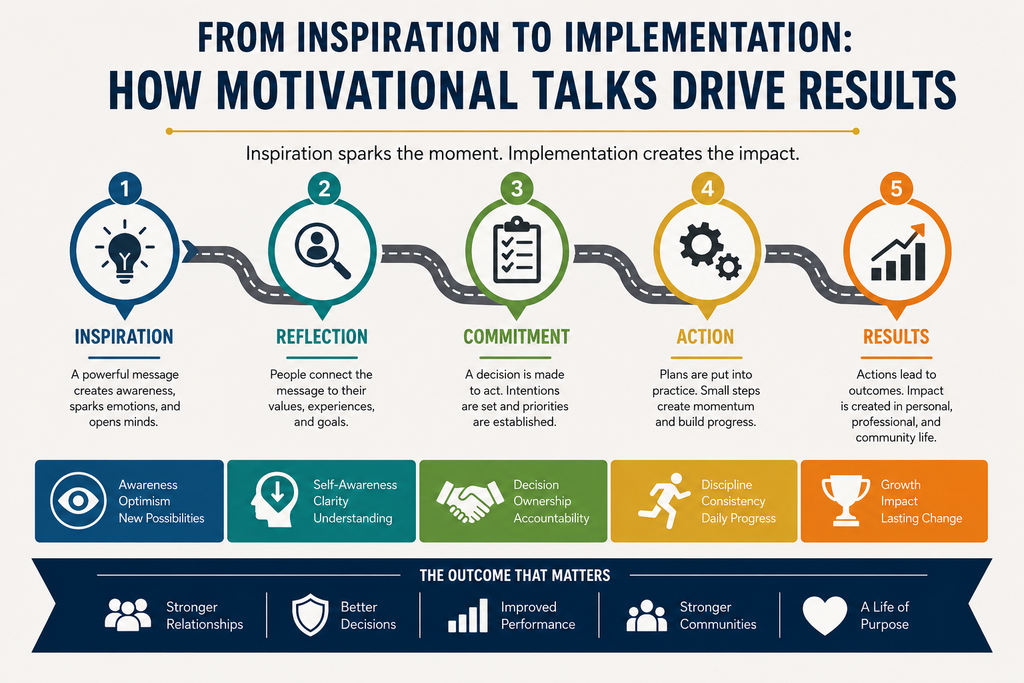
Effective motivational speaking does not reject emotion. Instead, it uses emotion as a starting point. The emotional response creates openness to a new idea. The idea creates reflection. Reflection can lead to purpose. Purpose encourages commitment. Commitment leads to action.
That progression creates a pathway toward results.
Dr. Stephen Swisher’s approach to motivating hearts can be understood within this larger framework. Reaching the heart is not simply about creating an emotional reaction. It can also mean encouraging people to examine their values, priorities, responsibilities, and relationships and then consider how those beliefs should influence their actions.
Purpose Gives Motivation Direction
Motivation without purpose can be difficult to sustain.
People may become enthusiastic about a goal but lose interest when the initial excitement disappears. Purpose provides a deeper reason to continue.
Purpose answers an essential question: Why does this matter?
When people understand why a goal matters, they are more likely to remain committed when obstacles appear. Purpose gives effort meaning.
For example, a person may want to become a better leader. The desire for professional advancement might provide motivation, but a deeper purpose—helping others develop, improving an organization, or making a meaningful contribution—can provide a stronger reason to persist.
Similarly, someone may want to become more involved in their community. Recognition may provide temporary motivation, but a genuine desire to serve others can create a more sustainable commitment.
Dr. Stephen Swisher’s work as a pastor naturally connects motivation with purpose. Building vibrant, spiritually strong communities requires more than encouraging people to feel inspired. It requires helping people understand why service, connection, responsibility, compassion, and participation matter.
Purpose turns motivation into direction.
Turning Ideas Into Practical Action
Implementation is where motivation becomes visible.
A motivational message might encourage people to become more resilient. Implementation asks what resilience looks like in practice.
It might mean responding differently to setbacks, seeking guidance, developing new skills, or continuing to pursue an important goal after experiencing disappointment.
A message about leadership can inspire people to lead with greater integrity. Implementation might involve listening more carefully, communicating expectations clearly, recognizing the contributions of others, and accepting responsibility when problems arise.
A message about community can inspire people to care more deeply about those around them. Implementation could mean volunteering, mentoring, supporting families, welcoming new members, or simply becoming more intentional about building relationships.
These actions may appear small, but small actions can create substantial results when they are repeated.
Dr. Stephen Swisher’s emphasis on motivational communication highlights this important connection between ideas and behavior. A message becomes more valuable when people can identify how to apply it.
The Importance of Specific Goals
Broad aspirations can be inspiring, but specific goals make implementation easier.
“I want to make a difference” is meaningful but vague.
“I will volunteer two hours each month” creates a specific action.
“I want to become a better communicator” is an aspiration.
“I will practice active listening during my next three important conversations” creates an actionable objective.
Motivational talks can help people make this transition from general intention to specific behavior.
Once an individual identifies a practical next step, the path forward becomes clearer. The goal no longer exists only as an idea. It becomes something that can be pursued.
Dr. Stephen Swisher’s message about moving from inspiration to implementation reinforces the value of making motivation practical. People need encouragement, but they also need clarity about what they can do next.
Personal Responsibility Drives Progress
No motivational speaker can create lasting change on behalf of an audience.
A speaker can encourage, challenge, teach, and inspire, but the individual must ultimately decide what to do with the message.
That is where personal responsibility becomes important.
Taking responsibility means recognizing that meaningful progress requires participation. It means asking what can be controlled, what needs to change, and what action can be taken.
Dr. Stephen Swisher’s focus on motivating hearts can encourage people to view themselves as contributors rather than observers. This perspective can be particularly powerful in community settings, where positive change depends on individuals taking responsibility for their roles.
A strong community does not emerge because a few people are motivated. It develops when many people decide to participate.
Motivational Speaking and Leadership
Leadership and motivational communication are closely connected.
Leaders influence how people understand challenges, opportunities, and responsibilities. Their words can shape organizational culture and community attitudes.
However, effective leadership requires more than inspirational language.
A leader who talks about teamwork must create opportunities for collaboration.
A leader who promotes accountability must establish clear expectations.
A leader who encourages growth must provide opportunities for people to learn.
A leader who speaks about purpose must connect everyday activities to meaningful objectives.
The same principle applies to motivational speakers.
Dr. Stephen Swisher demonstrates how purpose-driven communication can encourage people to see leadership as a responsibility rather than simply a position. Leadership becomes meaningful when individuals use their influence to encourage others, create opportunities, and contribute to positive outcomes.
Building Stronger Communities Through Action
Community building provides one of the clearest examples of the difference between inspiration and implementation.
Many people want stronger communities. They want people to feel connected, supported, and valued.
But those outcomes do not happen automatically.
Communities become stronger when individuals take action.
Someone welcomes a new person.
Someone mentors a young adult.
Someone volunteers at an event.
Someone listens to a neighbor who is struggling.
Someone organizes an opportunity for people to connect.
Someone encourages another person to pursue a goal.
These actions create relationships. Relationships create trust. Trust creates stronger communities.
As a pastor, Dr. Stephen Swisher understands the importance of motivating people to become active participants in community life. The vision of a vibrant, spiritually strong community becomes meaningful when people translate shared values into consistent behavior.
Inspiration establishes the vision. Implementation creates the reality.
Measuring Results Beyond Applause
One of the most important questions after a motivational talk is not, “Did people enjoy it?”
A more meaningful question is, “What happened afterward?”
Did people make different decisions?
Did they pursue new opportunities?
Did relationships improve?
Did individuals become more confident?
Did leaders become more effective?
Did people become more engaged with their communities?
Did participants follow through on commitments?
These questions focus attention on outcomes rather than temporary emotional responses.
Of course, not every meaningful result can be measured numerically. Greater confidence, renewed purpose, stronger relationships, and deeper community involvement may take time to become visible.
Nevertheless, motivational speaking becomes more impactful when it creates a measurable difference in behavior, engagement, or direction.
Dr. Stephen Swisher’s approach emphasizes the idea that encouragement should ultimately lead somewhere. The message is valuable because of what it inspires people to do.
Consistency Turns Motivation Into Momentum
One of the greatest challenges associated with motivation is maintaining momentum.
People often begin with enthusiasm and strong intentions. Then everyday responsibilities return. Progress slows. Obstacles appear. The initial emotional energy decreases.
Consistency provides the solution.
Meaningful change is usually created through repeated actions rather than one dramatic decision.
Someone who wants to improve leadership can practice one skill repeatedly.
Someone who wants to strengthen relationships can make regular time for meaningful conversations.
Someone who wants to serve the community can establish a consistent commitment to volunteering.
Someone pursuing personal growth can develop a routine of learning, reflection, or goal-setting.
Dr. Stephen Swisher’s focus on implementation reminds audiences that motivation should support an ongoing process. The objective is not simply to feel motivated today. It is to create momentum that continues tomorrow.
The Role of Authentic Communication
Authenticity makes motivational communication more meaningful.
Audiences are more likely to respond to messages that feel genuine, relatable, and connected to real human experiences.
Authentic motivation does not suggest that every challenge is easy. It acknowledges setbacks while reminding people that obstacles do not have to determine the final outcome.
For Dr. Stephen Swisher, motivating hearts involves connecting with people on a meaningful level. That connection can help audiences reflect on their experiences and consider how they can grow.
Authentic communication also builds trust. When people trust the messenger, they may be more open to considering challenging ideas and taking meaningful action.
Motivation Can Build Confidence
Motivation can also create a cycle of confidence and action.
A person may initially doubt whether they can accomplish something. An encouraging message can help them believe that progress is possible.
They then take a small step.
That step creates experience.
Experience creates confidence.
Confidence encourages another step.
Over time, this cycle can produce significant growth.
The process demonstrates why implementation is so important. Confidence is often strengthened not only by hearing that something is possible but by experiencing progress firsthand.
Dr. Stephen Swisher’s motivational approach can encourage people to take that first step and discover what becomes possible through consistent action.
Creating a Culture of Implementation
The principles of motivational speaking can extend beyond individuals.
Organizations, teams, churches, and communities can create environments that encourage implementation.
This might involve setting clear goals, assigning responsibilities, providing opportunities for participation, celebrating progress, and regularly evaluating what is working.
A culture of implementation asks an important question after every major idea: What happens next?
That question encourages accountability.
A vision becomes a plan.
A plan becomes a responsibility.
A responsibility becomes an action.
An action becomes a result.
A result provides information for the next decision.
This cycle allows motivation to become part of a culture of continuous improvement.
Spiritual Motivation and Meaningful Service
For spiritually oriented communities, motivation can have an especially meaningful dimension.
Faith can provide purpose, perspective, and a foundation for service. Yet spiritual values become most visible when they are expressed through action.
Compassion can become service.
Faith can become encouragement.
Leadership can become responsibility.
Community can become connection.
Dr. Stephen Swisher’s role as a pastor connects motivational communication with this broader understanding of purposeful action. Motivating hearts can mean encouraging people to live out the values they believe in through the way they treat others and contribute to their communities.
This connection between belief and behavior is one of the clearest examples of inspiration becoming implementation.
The Ripple Effect of Meaningful Motivation
The impact of a motivational message rarely stops with the original listener.
When someone becomes more confident, they may encourage another person.
When a leader becomes more intentional, an entire team may benefit.
When one person becomes more involved in a community, others may become more willing to participate.
When someone chooses to serve, that act can inspire additional acts of service.
This creates a ripple effect.
Dr. Stephen Swisher’s emphasis on building vibrant communities reflects the potential of that ripple effect. Individual transformation can contribute to collective transformation.
One inspired person can influence another.
One action can encourage another action.
Over time, those choices can help create a culture of participation and positive influence.
Making Motivation Sustainable
Sustainable motivation requires more than enthusiasm. It requires systems and habits that support continued action.
After hearing a motivational message, individuals can ask themselves several questions:
What is the most important lesson I heard?
Why does it matter to me?
What is one action I can take this week?
What obstacle might prevent me from following through?
Who can hold me accountable?
How will I recognize progress?
These questions transform inspiration into an implementation plan.
For organizations and communities, similar questions can guide follow-up meetings, mentoring programs, action plans, and accountability systems.
The goal is to make motivation practical enough to survive beyond the original event.
From Inspiration to Implementation
The journey from inspiration to implementation is ultimately about transforming possibility into progress.
Inspiration opens people to new ideas.
Purpose gives those ideas direction.
Reflection creates clarity.
Commitment creates ownership.
Action creates momentum.
Consistency creates lasting results.
Dr. Stephen Swisher represents an approach to motivational communication in which encouragement is connected to meaningful purpose and positive action. His work as a pastor demonstrates how motivating hearts can contribute to stronger individuals and vibrant, spiritually strong communities.
The most successful motivational talk may not be the one that produces the loudest applause. It may be the one that changes what someone does the next morning.
It might encourage a person to pursue a meaningful goal.
It might motivate a leader to listen more carefully.
It might inspire someone to volunteer.
It might help a person rebuild confidence after a setback.
It might encourage someone to reconnect with their purpose.
Those outcomes demonstrate the real power of motivation.
A message creates its greatest impact when it continues to influence decisions long after the speaker has finished.
For more information about Dr. Stephen Swisher and his work, visit Dr. Stephen Swisher’s official website.
Readers can also learn more about Dr. Stephen Swisher on Lifestream Networks and explore his broader professional presence and perspective.
Inspiration starts the journey. Purpose provides the direction. Implementation creates the results.